Day 4
Forty hours, almost no support material
The feet came out hairy, so we rebuilt the print file round one idea: stop swapping nozzles. Now only one plate uses support material, and the whole duck is about 40 hours.
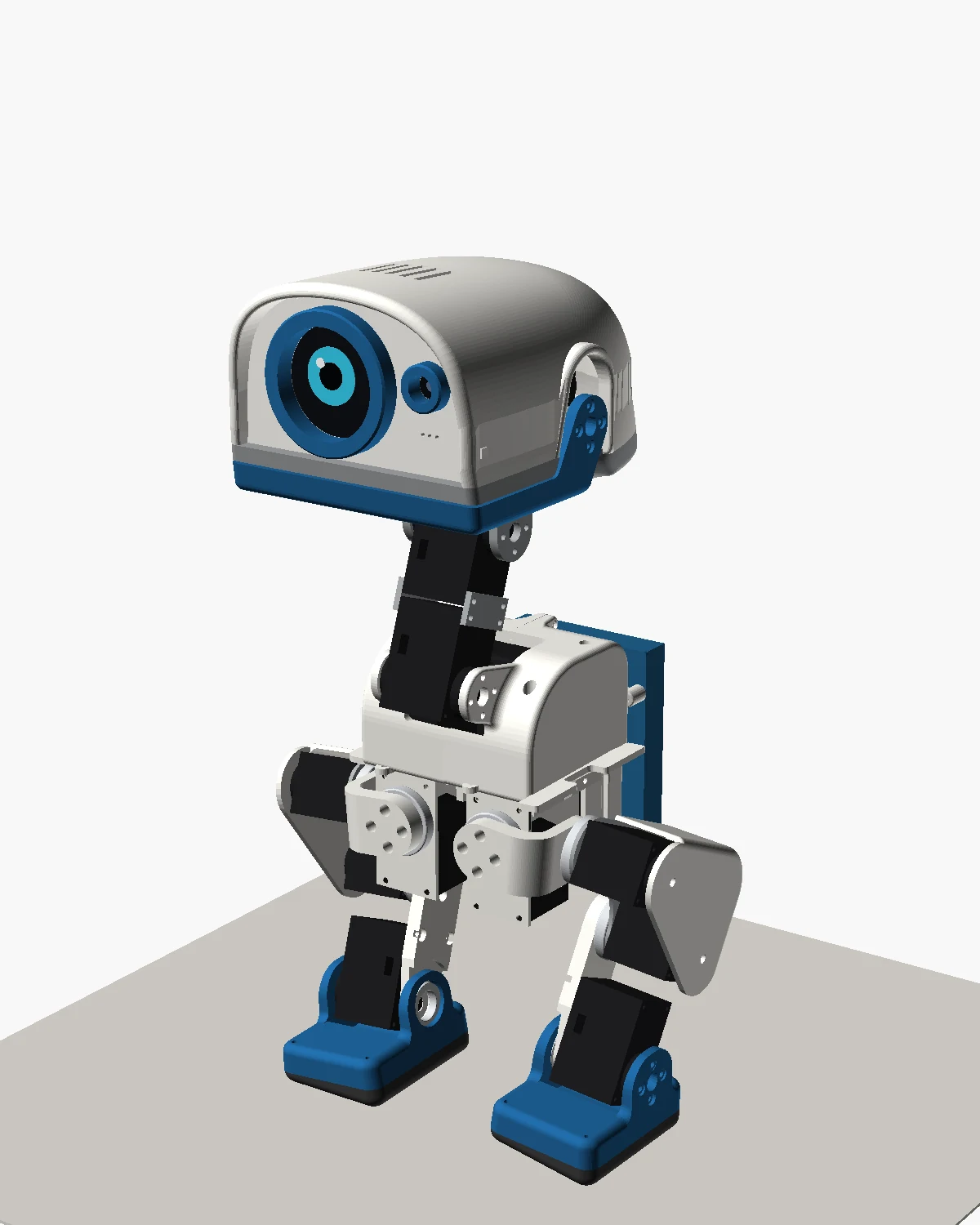
The feet (B2) came off the plate with blue ooze hairs and clear strings on both uprights, and blue support stubs inside the bearing ring. All their support was inside the holes through the uprights, and because the support had tips of support material, the printer swapped nozzles 62 times to make it.
That's the same thing that made the hip outputs stringy two days earlier. Every swap can drag a hair of plastic, and every plate that swaps needs a prime tower and purging, which cost about 30 g of filament and two or three hours per plate.
The new rule
- Support in the part's own filament, with a small gap so it snaps off: 0.16 mm on the fine 0.08 mm-layer parts, 0.12 mm on the rest.
- No support inside holes up to 16 mm across. They print fine as arches, as the feet showed. The build script finds the roof of every hole that size and paints a support blocker on it.
- Check every plate with supports off and list anything that would print over thin air, with how far it reaches and whether it's a bridge or a cantilever. Plates with nothing on that list don't get supports at all.
Only two plates still touch support material: the leg links (W8), for the one recess that needs it, and the hip outputs (W7), whose supports keep a few layers of it on top. Every other plate is a single filament, with no nozzle swaps and no prime tower.
The hole blocker is a little ray test in the build script: for every downward-facing triangle, it looks straight down and sideways, and if the part closes round it within 16 mm, it's the roof of a hole and gets painted "no support". The first run painted nothing at all, because the paint was applied after the triangles had already been written to the file. A one-line count of painted triangles in the finished file caught it.
What it saved
- The feet: 3 h 23 min and 31 g, down from 5 h 46 min and 55 g.
- The hood (H1): its curved roof met support tips on almost every layer near the top of the dome, 194 swaps while the most visible surface printed. It now uses plain white tree supports. 12 h 09 min and 100 g, down from 17 h 47 min and 156 g.
- The whole duck: about 40 hours over 20 plates. Roughly 260 g of white, 66 g of grey, 54 g of blue and 33 g of TPU.
How the file is laid out
Each plate holds one big part or one matched pair, so a failed print only costs that plate. Visible curved parts print at 0.08 mm layers with three walls; brackets and links at 0.12 mm with four walls and 40% gyroid infill. There's no ironing, because matte filament goes blotchy. It needs a 0.4 mm nozzle in both sides of the H2D, and everything prints from the left one.
If you're printing the standard files on any other printer, the designers' advice stands: print one servo mount and one bearing seat first, and check they fit your actual servo and bearing before committing 40 hours.